Feeds:
Posts
Comments

Archive for the ‘Uncategorized’ Category

CRAFTMANSHIPHaving just completed the acquisition of Chubb, ACE will adopt the Chubb name globally, and parent company Chubb Limited is listed under the symbol “CB” on the New York Stock Exchange and is a component of the S&P 500 index.  The “new Chubb” has become the world’s largest publicly traded property and casualty insurance company, and is intent on differentiating itself from other carriers.

To convey how Chubb differs from other insurance carriers, Chubb has produced a video explaining a focus on refining “the craft of insurance”.  While many carriers marketing efforts falsely suggest insurance coverage is a mere commodity, Chubb reminds consumers insurance coverage is not generic.

“It’s personal. It’s about the people and things that matter to you. Your family and loved ones. Your home and your business. Your employees and shareholders. At Chubb, when we write a policy, we write it for you. We believe insurance is more than underwriting, it’s a craft.”

I encourage all to view Chubb’s new video about the craftsmanship of insurance: http://bcove.me/vy7d3i7f


Read Full Post »

head-in-sand1Neither a scientist nor climatologist, I do not have firm views on why our global climate is changing. Meanwhile, it surprises me how many continue to deny our global climate IS changing. Hopefully, a new report issued by the UN Office for Disaster Risk Reduction (UNISDR) and the Belgian-based Centre for Research on the Epidemiology of Disasters (CRED) will lend some clarity. While the report is careful not to assert why changes have occurred, it provides clear data that may help climate change deniers accept changes in our climate have occurred over the past two decades.

The report was released to coincide with the gathering of world leaders in Paris this week to discuss plans to curb greenhouse gas emissions and prevent world temperatures rising. To examine this very readable 27 page report, either key word search the term “Human Cost of Weather Related Disasters” or or simply click this link  to access the UNISDR Weather Disasters Report 2015 to access the report online.

The report found there were an average of 335 “weather-related disasters” (floods, heatwaves, drought, earthquakes, storms, etc.) annually between 2005 and August 2015, almost twice as many as occurred during the years from 1985 to 1994.  The countries with the highest number of weather-related disasters over the past decade were the United States, with 472, China with 441, India with 288, the Philippines with 274 and Indonesia with 163.  While earthquakes, volcanoes and tsunamis often capture the headlines, they represent only 1 in 10 of the disasters defined by the impact. Floods accounted for 47% of all weather-related disasters from 1995-2015, affecting 2.3 billion people and killing 157,000. Becoming better prepared to address increased flooding is perhaps the biggest risk management take-away from the report, as supported by this important observation.

“All we can say is that certain disaster types are increasing. Floods are definitely increasing. Whether it’s increasing due to global warming, I think it’s safe to say the jury’s out on that. But rather than focus on the ifs, whys and wherefores, I think we should focus on how to manage floods.”  Debarati Guha-Sapir, professor at the Centre for Research on the Epidemiology of Disasters at UCL University in Louvain, Belgium.

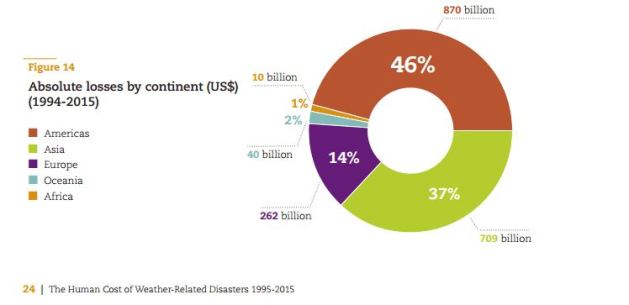
Of course, the impact of the financial losses caused by weather-related disasters reflects the greater financial impact sustained in more developed areas, as evidenced by this graphic.  Cost Weather Related Disasters
While it goes without saying debate over the causes and solutions to climate change will continue, consumers should be aware ALL in the insurance industry have witnessed the changes that are occurring and the resulting impact. How the industry decides to respond to those changes will remain an evolving story.

Read Full Post »

The Internet will eliminate many of the “Helper” businesses whose sole value is that or a mere intermediary or conduit.

Source: The Demise of The Middleman

Read Full Post »

flood 2

A study by a noted hydrologist earlier this year of major Midwestern rivers in the Journal of Earth Science found that Federal Emergency Management Agency (FEMA) and the U.S. Army Corps of Engineers (USACE) have grossly underestimated the threat of severe floods in many communities.

The implications of the error are alarming, as calculations of flood severity and frequency are used to determine how high to build levees and floodwalls, where to approve development in floodplains, and also guide flood insurance requirements and costs. Consider the impact for residents in Mark Twain’s hometown of Hannibal, Missouri.  In 2013, Hannibal had a 50-year flood, meaning a severe flood event calculated to occur once every 50 years. In 2014, Hannibal had another 50-year flood.  Of course, each year the odds of such an event are the same, 1 in 50, so statisticians would urge us to take a longer view.

Here’s a longer view: the Mississippi River also reached its 10-year flood stage in Hannibal in seven of the last eight years. Hannibal also had a 200-year flood in 2008, as well as 1993.  For those keeping score: 100 year floods twice in 25 years, 10 year floods 7 in 8 years and a 50 year flood twice in 2 years.  Experts in statistics have examined the odds and decided to search for a more plausible explanation. By the way, for those who suspect global warming is the cause, climate change seems to be only a small part of the problem.  The bigger contributor: the unintended effects of engineered river control systems.

Since you likely don’t live in Hannibal, Missouri, why does this matter?

Floods are becoming more frequent and severe, and if the calculations used to project the likelihood of severe flooding by the Army Corps of Engineers are so flawed in Hannibal, isn’t it possible those flaws are also distorting the risk of severe flooding where you reside?   To learn more about the study being referenced: www.sciencedaily.com

My Suggestion: review the few residential flood facts below and consider contacting an insurance professional to learn about the cost and benefits of adding flood insurance protection for your home(s).

  • In the past 5 years, all 50 states have experienced a flood.
  • Each year, floods are the number 1 natural disaster in the United States.
  • Everyone is at risk, even those who do not live close to rivers and lakes or a large body of water.
  • More than 20 percent of all flood claims are for properties located outside of areas designated as high-risk flood zones.

Read Full Post »

I don’t often re-blog another’s post, but this is from a brilliant writer and is well worth sharing.

TonyCanas's avatarInsNerds.com

Recently, Carly and Tony received an amazing email from Warren Buffett, the Oracle of Omaha himself, congratulating us for InsNerds.com, confessing that he’s a big fan of our efforts and inviting us on an all expenses-paid trip (onNetJets of course) to have dinner with him to discuss the industry. We had an amazing time over the 3-hour dinner at Gorat’s Steak House. The best part was being able to pick his brain about the awesome industry we work in…

Sadly, then the alarm clock went off at 5 am, and Tony realized he was dreaming. There was no email from Warren Buffett, no invitation for dinner, and no flight on NetJets.

But all is not lost. Uncle Warren has written extensively about the insurance industry through 38 years worth of Letters to the Shareholders of Berkshire Hathaway which he has published every year since 1977. All this wisdom…

View original post 714 more words

Read Full Post »

chubbAsk someone familiar with branding this question, and they will explain a person’s or organization’s name conveys a brand.  Good, bad, or unfamiliar, names convey a brand.  Donald Trump and Colin Powell.  Two very different brands.  Ritz Carlton and Hotel 6.  Again, two distinctly different brands.   Coke and Pepsi. Two brands that are quite similar. John Public and Mary Doe? Nothing — I don’t know them either. Now, consider these two prominent insurance companies: Ace and Chubb.  I view Ace and Chubb as very similar and very different.

Among the ways Ace and Chubb are very similar: financial performance.  According to Fitch Ratings: “For the five-year period 2010-2014, ACE’s average consolidated GAAP combined ratio was 91 and the operating return on equity was 12 percent. Chubb’s average combined ratio and operating return on equity for the same period was 91 and 13 percent, respectively.” That’s pretty similar.

Among the ways Ace and Chubb are very different: how their brands are perceived. Says Ace Chairman and CEO Evan Greenberg: “The combined global operation will operate under the Chubb name, an acknowledgement of the distinctiveness and recognition of its brand, particularly in the U.S.”   

Recognizing the importance of “what’s in a name”, Ace, the acquiring company, has shown the wisdom of moving forward using the acquired company’s brand.  Ace will re-brand as Chubb, the ultimate compliment. Those who question the importance and value of a brand should take note — and believe in the power of the Chubb brand.

Read Full Post »

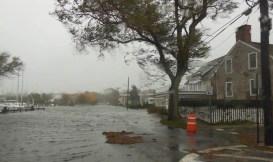
sag flood sceneFEMA provides a very helpful online tool that allows consumers to complete three easy steps to find the important flood hazard data for virtually any given property.

Click here for a link to a FEMA site to see the flood risk data for ANY location that can be found on their highly interactive map.

Are there viable risk management strategies that can reduce the extent of damage should flood water enter your property? YES —– check the following link to learn more about the many benefits of installing foundation flood vents:  http://smartvent.com/howwhatwhy 

Contact me if you would like to be introduced to an independent insurance and risk advisor in your state who has local expertise in helping consumers better understand their exposure to flood damage, control the associated costs of flood insurance, and adopt loss mitigation strategies to reduce the impact of a flood.

Read Full Post »

According to researchers from the U.S. Geological Survey, more than 143 million people residing in the lower 48 United States are vulnerable to earthquakes. The risk for those on the Pacific coast is well known, but those residing in the Rockies, Midwest, New England and parts of the Southeast also face an elevated risk. More alarming is the fact the study does not factor in earthquakes attributed to oil and natural gas “fracking” activities. While the U.S. Geological Survey site is very technical, we offer this link that summarizes their recent findings should you wish to learn more.

We share the news of this report not to create undue alarm, but as a reminder that homeowners insurance policies do not provide coverage for damage to your residence that is caused by earth movement.  As with most risks, insurance coverage for earthquake and other earth movement is available and worth considering.   To learn more about your options contact your personal risk advisor.

Read Full Post »

Premiums received from all drivers are used by insurance carriers to pay the disproportionate claims caused by bad drivers, which creates a cost impact even for safe drivers.

To better understand just how inept some drivers are, check this video from You Tube:   https://www.youtube.com/watch?v=Z7FqHJh6Ty4

Read Full Post »

Check the link below for a great report by NBC News: Security experts warn that cyber criminals are setting up fake WiFi hotspots, luring consumers to hand over the keys to their computers. And travelers are falling for this at an alarming rate. BeAware!

http://www.nbcnews.com/nightly-news/video/how-to-protect-yourself-against–free-wifi–scams-415603779813

Read Full Post »

« Newer Posts - Older Posts »