Feeds:
Posts
Comments

PlainfieldIn his book “Start With Why”, author Simon Sinek offers readers many insights, with none more important than this one: “If you talk about what you believe, you will attract those who believe what you believe.”

Sinek’s book essentially details the research that helped him to arrive at this groundbreaking “discovery”: more important to consumers than learning what our products and services can do, or even how our solutions may be superior to those provided by our competitors, what consumers really want to know is what you believe — or what Sinek describes as your “Why”.  (It could be argued Aristotle identified this just a few years earlier as the important appeal to emotion – or ethos – in his lesson explaining the three essential components to the art of persuasion)

Does focusing consumers on your “Why” conflict with conventional sales and marketing thought leadership?  After all, haven’t we been encouraged to uncover our customer’s wants and needs, and then explain the customized and helpful solutions we have structured to meet those unmet needs? Or, since Sinek’s research indicates consumers’ real “wants” are to conduct business with those who understand and can explain their “why”, isn’t it possible that by explaining our “why” we are actually providing what consumers really want?  Think about it.

Consider your own value proposition for a moment or two.  Is it focused on explaining to others what you do / who you serve /  how your solution is different and better?  If so, the good news is your value proposition is just like most others.  You explain your what and how. The not so good news: it is not focused on what Sinek’s research indicates to be the real wants of those you serve.  Where is your why?  No ethos??  Consider Sinek and Aristotle. You can do better.

What does any of this have to do with “the ‘hood?!”  My hometown is one that many would refer to as “the ‘hood”. (Plainfield, NJ for those who are interested, still a great town in my opinion) Although after college many years ago I moved far away, it remains an important part of who I am, and I visit regularly. When I return, at least a few I re-connect with will end a conversation with the question “Do you feel me?”  Not only in this town, but in many others like it. During a recent trip, hearing this question caused me to think of Simon Sinek’s “discovery” and caused me to think: if Sinek had been from my hometown, he may have spared himself years of research. Those in my hometown and others like it have always known: when trying to positively influence others, you want those you are speaking with to think “I feel you!” when you speak with them.

Do you feel me?  I am pretty sure Simon Sinek would.

What do you believe? Have you explained that to those you serve?  If not,why not? 

when not to pass on the leftAs a newly licensed driver, those were the words I heard from my mother each time I left the house. While I did not know exactly just what the “other guy” was capable of, I was always on the lookout!

Many I speak with wonder why the cost to insure their car is what it is since they have never had an accident. Of course, insurance carriers collect premiums from all drivers, and use more than half of all of the premiums collected to pay the costs to settle claims for those who do sustain an accident.  While some accidents are just that — accidents that are difficult to avoid — many more are caused by drivers who are either reckless or remarkably unskilled.  The costs arising from accidents caused by reckless and unskilled drivers contribute greatly to the cost of insurance for all drivers.

To better understand just how reckless and inept some drivers are, check this video from You Tube:   https://www.youtube.com/watch?v=Z7FqHJh6Ty4

Regardless of your experience: Remember to drive safely, and especially to look out for the “other guy”!

CRAFTMANSHIPHaving just completed the acquisition of Chubb, ACE will adopt the Chubb name globally, and parent company Chubb Limited is listed under the symbol “CB” on the New York Stock Exchange and is a component of the S&P 500 index.  The “new Chubb” has become the world’s largest publicly traded property and casualty insurance company, and is intent on differentiating itself from other carriers.

To convey how Chubb differs from other insurance carriers, Chubb has produced a video explaining a focus on refining “the craft of insurance”.  While many carriers marketing efforts falsely suggest insurance coverage is a mere commodity, Chubb reminds consumers insurance coverage is not generic.

“It’s personal. It’s about the people and things that matter to you. Your family and loved ones. Your home and your business. Your employees and shareholders. At Chubb, when we write a policy, we write it for you. We believe insurance is more than underwriting, it’s a craft.”

I encourage all to view Chubb’s new video about the craftsmanship of insurance: http://bcove.me/vy7d3i7f


head-in-sand1Neither a scientist nor climatologist, I do not have firm views on why our global climate is changing. Meanwhile, it surprises me how many continue to deny our global climate IS changing. Hopefully, a new report issued by the UN Office for Disaster Risk Reduction (UNISDR) and the Belgian-based Centre for Research on the Epidemiology of Disasters (CRED) will lend some clarity. While the report is careful not to assert why changes have occurred, it provides clear data that may help climate change deniers accept changes in our climate have occurred over the past two decades.
The report was released to coincide with the gathering of world leaders in Paris this week to discuss plans to curb greenhouse gas emissions and prevent world temperatures rising. To examine this very readable 27 page report, either key word search the term “Human Cost of Weather Related Disasters” or or simply click this link  to access the UNISDR Weather Disasters Report 2015 to access the report online.

The report found there were an average of 335 “weather-related disasters” (floods, heatwaves, drought, earthquakes, storms, etc.) annually between 2005 and August 2015, almost twice as many as occurred during the years from 1985 to 1994.  The countries with the highest number of weather-related disasters over the past decade were the United States, with 472, China with 441, India with 288, the Philippines with 274 and Indonesia with 163.  While earthquakes, volcanoes and tsunamis often capture the headlines, they represent only 1 in 10 of the disasters defined by the impact. Floods accounted for 47% of all weather-related disasters from 1995-2015, affecting 2.3 billion people and killing 157,000. Becoming better prepared to address increased flooding is perhaps the biggest risk management take-away from the report, as supported by this important observation.

“All we can say is that certain disaster types are increasing. Floods are definitely increasing. Whether it’s increasing due to global warming, I think it’s safe to say the jury’s out on that. But rather than focus on the ifs, whys and wherefores, I think we should focus on how to manage floods.”  Debarati Guha-Sapir, professor at the Centre for Research on the Epidemiology of Disasters at UCL University in Louvain, Belgium.

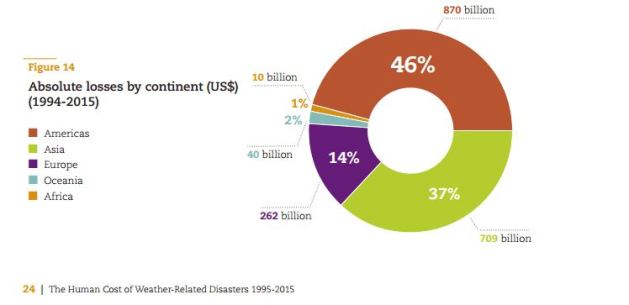
Of course, the impact of the financial losses caused by weather-related disasters reflects the greater financial impact sustained in more developed areas, as evidenced by this graphic.  Cost Weather Related Disasters

While it goes without saying debate over the causes and solutions to climate change will continue, consumers should be aware ALL in the insurance industry have witnessed the changes that are occurring and the resulting impact. How the industry decides to respond to those changes will remain an evolving story.

The Internet will eliminate many of the “Helper” businesses whose sole value is that or a mere intermediary or conduit.

Source: The Demise of The Middleman

flood 2

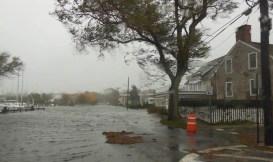
A study by a noted hydrologist earlier this year of major Midwestern rivers in the Journal of Earth Science found that Federal Emergency Management Agency (FEMA) and the U.S. Army Corps of Engineers (USACE) have grossly underestimated the threat of severe floods in many communities.

The implications of the error are alarming, as calculations of flood severity and frequency are used to determine how high to build levees and floodwalls, where to approve development in floodplains, and also guide flood insurance requirements and costs. Consider the impact for residents in Mark Twain’s hometown of Hannibal, Missouri.  In 2013, Hannibal had a 50-year flood, meaning a severe flood event calculated to occur once every 50 years. In 2014, Hannibal had another 50-year flood.  Of course, each year the odds of such an event are the same, 1 in 50, so statisticians would urge us to take a longer view.

Here’s a longer view: the Mississippi River also reached its 10-year flood stage in Hannibal in seven of the last eight years. Hannibal also had a 200-year flood in 2008, as well as 1993.  For those keeping score: 100 year floods twice in 25 years, 10 year floods 7 in 8 years and a 50 year flood twice in 2 years.  Experts in statistics have examined the odds and decided to search for a more plausible explanation. By the way, for those who suspect global warming is the cause, climate change seems to be only a small part of the problem.  The bigger contributor: the unintended effects of engineered river control systems.

Since you likely don’t live in Hannibal, Missouri, why does this matter?

Floods are becoming more frequent and severe, and if the calculations used to project the likelihood of severe flooding by the Army Corps of Engineers are so flawed in Hannibal, isn’t it possible those flaws are also distorting the risk of severe flooding where you reside?   To learn more about the study being referenced: www.sciencedaily.com

My Suggestion: review the few residential flood facts below and consider contacting an insurance professional to learn about the cost and benefits of adding flood insurance protection for your home(s).

  • In the past 5 years, all 50 states have experienced a flood.
  • Each year, floods are the number 1 natural disaster in the United States.
  • Everyone is at risk, even those who do not live close to rivers and lakes or a large body of water.
  • More than 20 percent of all flood claims are for properties located outside of areas designated as high-risk flood zones.

Claim denied 1Purchasing an insurance policy enables us to shift the financial risk of paying for certain losses to an insurance carrier in exchange for the premiums we remit.   The terms and conditions of the transaction are detailed in a legal contract, or the insurance policy we receive. Knowing how hard it is for consumers to compare and contrast the terms and conditions between different policies, many insurance carriers market their policies by focusing consumer attention on the one part of the transaction they well understand: the cost. Meanwhile, savvy consumers and the trusted advisors who guide them should ask how it is some insurance carriers that sell policies at a cost far lower than other carriers can still earn a profit. Have some carriers developed a secret strategy? 

Their Secrets Revealed

One strategy some carriers use to lower the cost of coverage while maximizing their profits is to issue policies that protect consumers from fewer risks.  This works quite well, as the subtle yet important differences in the policy language (the proverbial “contract fine-print”) that detail the risks that are and are not covered by different insurance policies is very hard for consumers to discern. Another strategy some of these carriers use to maximize profits is to adopt claims practices that make it extra difficult for claimants to be reimbursed for losses that are covered.  In this scenario, aggrieved policyholders seeking payments that have been denied for losses that are covered by their policies must rely upon state regulators and the legal system to determine if the claims practices used by such carriers are or are not consistent with the terms of the contract.  For the many policyholders who do not experience a loss, both of these strategies can be dismissed as “no harm, no foul”.  Until a loss occurs.

A Simple Formula To Make Better Decisions

Consumers wishing to avoid learning these lessons the hard way — after a loss for which coverage is either deficient or inexplicably denied —- can be assured the remedy is both simple and logical:  conduct better research!  Here’s the simple two step formula:

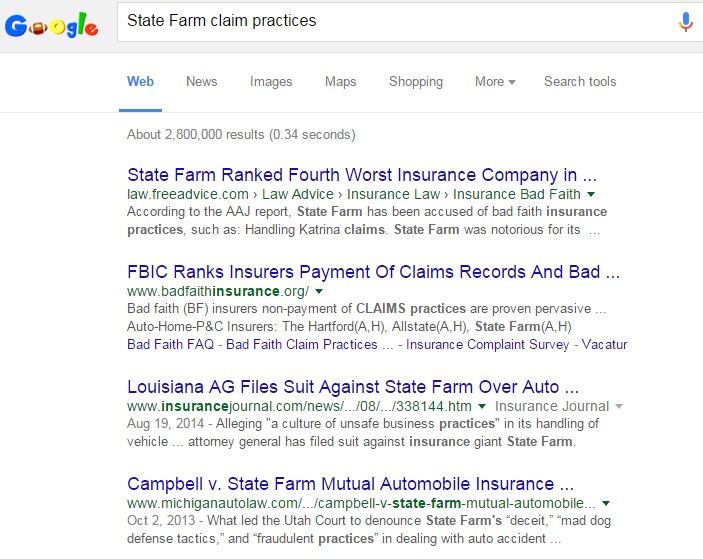
  1. Enter the name of your insurance carrier (or a carrier are considering) in your search browser and then add these two words: carrier’s name claim practices”.
  2. Carefully examine the content on some of the sites revealed by the search to better understand that carrier’s approach to responding to the claims of their policyholders.

That’s it – just taking those 2 steps can arm consumers with important insights needed to make better-informed decisions and begin selecting coverage from insurance carriers that is actually worth paying for!

Why use the words “claims practices” in your search?  Again, more important than knowing the cost of coverage is to learn if the insurance you are paying actually honors their contractual obligations!  Do not rely on popular who-is-the-best-carrier survey results, as those findings include a number of less important criteria that are not reflective of a carrier’s claims paying practices.  Instead, research the two words that will reveal important insights on an insurance carrier’s claim practices and examine the far more revealing insights.

Search Results Can Be Eye-Opening!

The time-honored business practice of “not speaking poorly of competitors” is one I understand and respect.  To remove the appearance of bias and finger pointing, I encourage consumers to use the power of the internet to perform the above search for ANY insurance carrier. To illustrate the revealing insights that can be gained, consider just the first few results that appear in the screenshots below for a search on the two companies that insure more homes and cars than any other carriers in the United States.

Google SF

Google AS

To be fair: these carriers are often able to save many policyholders hundreds of dollars each year in premiums, just as their advertisements promise. Examining their claim practices can help to explain how they can do so while still earning a profit.

In Conclusion:  This information is provided in an effort to arm consumers with the insights needed to make better informed decisions about their insurance protection.  To protect ourselves from the shell-game advertising tactics that cleverly shift our focus away from what really matters (being paid after a covered loss) to something of lesser consequence but providing an immediate result we all want (a lower premium), it is critical to conduct better research. On any carrier. Then, read the reviews.  Those reviews can often expose the business strategies used by some carriers to fund the “savings” they have advertised to lure your business.

Think I’m making this up? To read an astonishing investigative report that details how State Farm and Allstate contracted with consulting firm McKinsey and Company to reduce their claims costs, simply enter the four words “McKinsey State Farm Allstate” into any search engine. Of all that has been reported about this sordid tale, The Insurance Hoax as reported in Bloomberg News is the most revealing. If you prefer video, check this CNN report by Anderson Cooper available on You Tube.     

Let the buyer BeAware!

teen driverThis time each year, it seems the media is full of back-to-school protection tips advising parents and college students on how to protect their “stuff”.  While the guidance is helpful, these tired articles commonly ignore the host of emerging risks that can expose a family’s assets and jeopardize the welfare of their child.   

Every parent of a college student understands the degree to which their child seems tethered to their smart phone and other connected technology.  The common condition of being too connected has been termed “virtual addiction”, a condition so common there is a website that offers on-line questionnaires to help the public examine the degree to which addiction describes their relationship with technology:   http://virtual-addiction.com/smartphone-abuse-test/  (these tests are eye-opening…)  Whether the student’s use of technology qualifies as an addiction or not, very few college students today are not at least heavy users of modern technology.

As a result, today’s college students face risks that are far more grave that a stolen laptop!  Consider the following risks that can arise from the improper and unmonitored use of the modern technology at every student’s disposal:

  • loss of privacy
  • computer malware or virus
  • stolen identity and personal information
  • mis-use of social media that can cause harm to another
  • texting, e mailing, snapchatting, taking selfies or just plain talking on a cell phone while driving
  • sending, receiving and or forwarding illegal content

The insurance industry can help parents and students to better prepare for the above issues.  Consider reviewing this helpful series of recommendations from ACE Private Risk Services.  For those with college students and younger children, this helpful guide from Chubb offers a number of protection insights.

In addition to having a complete discussion with your child about the risks that can arise from their mis-use of technology, following are two specific protection recommendation I can also offer:

  1. Make sure the homeowner policy that provides primary liability protection for family members includes coverage for “personal injury” related risks: libel, slander, defamation, and other verbal torts. MANY homeowner policies do not!  Be sure to supplement this primary liability protection with adequate excess liability insurance.
  1. If your college student is at school with the use of a car, install a device that restricts the use of their cell phone while operating that car! There are a growing number of providers for this important safety service, but this device from cell control has been well reviewed. (why not also take this step for those children driving cars while at home?)   Preventing distracted driving is achievable, and a cause I am passionate about.


I don’t often re-blog another’s post, but this is from a brilliant writer and is well worth sharing.

TonyCanas's avatarInsNerds.com

Recently, Carly and Tony received an amazing email from Warren Buffett, the Oracle of Omaha himself, congratulating us for InsNerds.com, confessing that he’s a big fan of our efforts and inviting us on an all expenses-paid trip (onNetJets of course) to have dinner with him to discuss the industry. We had an amazing time over the 3-hour dinner at Gorat’s Steak House. The best part was being able to pick his brain about the awesome industry we work in…

Sadly, then the alarm clock went off at 5 am, and Tony realized he was dreaming. There was no email from Warren Buffett, no invitation for dinner, and no flight on NetJets.

But all is not lost. Uncle Warren has written extensively about the insurance industry through 38 years worth of Letters to the Shareholders of Berkshire Hathaway which he has published every year since 1977. All this wisdom…

View original post 714 more words

BuyerBeAwareThere are a number of policy provisions and claims settlement procedures that enable some car insurance carriers to dramatically reduce their costs when repairing a damaged vehicle.  The good news: those carriers are often able to charge less for insurance, since their repair costs are lower.

The bad news: This shocking recent report by CNN and Anderson Cooper explains that over 500 car repair shops in 36 states accuse many auto insurance companies of coercing them to use cheap parts and sometimes dangerous practices to fix vehicles involved in accidents.  The video evidence is alarming, and serves to remind insurance consumers the axiom “you get what you pay for” also applies to insurance coverage.

I encourage readers to examine this revealing report, and to contact a reputable Independent Agent to learn why it is important to consider the many benefits of insuring your vehicles with an insurance carriers like AIG, ACE, Chubb and PURE that provide coverage for repairs using OEM (original equipment of the manufacturer) parts, while also permitting their savvy policyholders to select the repair facility of their choice.