
 Neither a scientist nor climatologist, I do not have firm views on why our global climate is changing. Meanwhile, it surprises me how many continue to deny our global climate IS changing. Hopefully, a new report issued by the UN Office for Disaster Risk Reduction (UNISDR) and the Belgian-based Centre for Research on the Epidemiology of Disasters (CRED) will lend some clarity. While the report is careful not to assert why changes have occurred, it provides clear data that may help climate change deniers accept changes in our climate have occurred over the past two decades.
The report was released to coincide with the gathering of world leaders in Paris this week to discuss plans to curb greenhouse gas emissions and prevent world temperatures rising. To examine this very readable 27 page report, either key word search the term “Human Cost of Weather Related Disasters” or or simply click this link to access the UNISDR Weather Disasters Report 2015 to access the report online.
The report found there were an average of 335 “weather-related disasters” (floods, heatwaves, drought, earthquakes, storms, etc.) annually between 2005 and August 2015, almost twice as many as occurred during the years from 1985 to 1994. The countries with the highest number of weather-related disasters over the past decade were the United States, with 472, China with 441, India with 288, the Philippines with 274 and Indonesia with 163. While earthquakes, volcanoes and tsunamis often capture the headlines, they represent only 1 in 10 of the disasters defined by the impact. Floods accounted for 47% of all weather-related disasters from 1995-2015, affecting 2.3 billion people and killing 157,000. Becoming better prepared to address increased flooding is perhaps the biggest risk management take-away from the report, as supported by this important observation.
“All we can say is that certain disaster types are increasing. Floods are definitely increasing. Whether it’s increasing due to global warming, I think it’s safe to say the jury’s out on that. But rather than focus on the ifs, whys and wherefores, I think we should focus on how to manage floods.” Debarati Guha-Sapir, professor at the Centre for Research on the Epidemiology of Disasters at UCL University in Louvain, Belgium.
Of course, the impact of the financial losses caused by weather-related disasters reflects the greater financial impact sustained in more developed areas, as evidenced by this graphic. 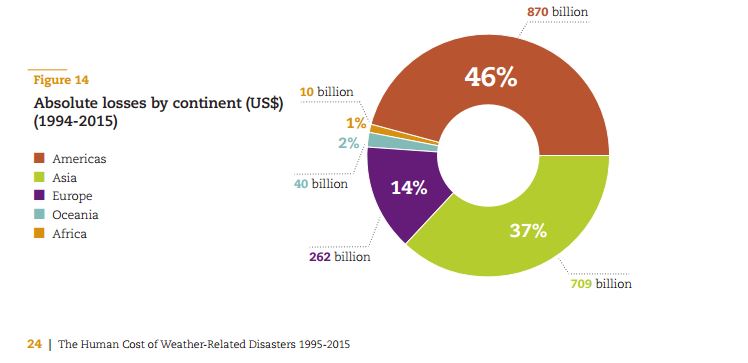
While it goes without saying debate over the causes and solutions to climate change will continue, consumers should be aware ALL in the insurance industry have witnessed the changes that are occurring and the resulting impact. How the industry decides to respond to those changes will remain an evolving story.